
ENERGY & POWER GROUP
2026-03-01
Project Background
This multinational energy and power enterprise operates power grid systems, new energy bases and regional power facilities across multiple regions. Its core business covers grid data collection, load forecasting, energy settlement and industry compliance reporting. The company previously faced typical batch scheduling challenges in large-scale global operations.
Decentralized task execution: Business tasks were scattered across heterogeneous servers and regional isolated systems, resulting in messy task dependencies, poor synergy and low overall operational efficiency.
Strict time window constraints: Daily statistics, monthly settlement and carbon data reconciliation required high-precision batch processing. Traditional script-based scheduling and manual intervention frequently caused delays and data calculation errors.
Insufficient compliance control: Local industry supervision required full-process traceable operation logs and non-tamperable core data. Original tools lacked unified audit and standardized compliance management capabilities.
Single-point failure risks: Independent regional scheduling nodes had no fault tolerance mechanism, easily interrupting continuous equipment data collection and affecting stable operational analysis.
Technical Solution
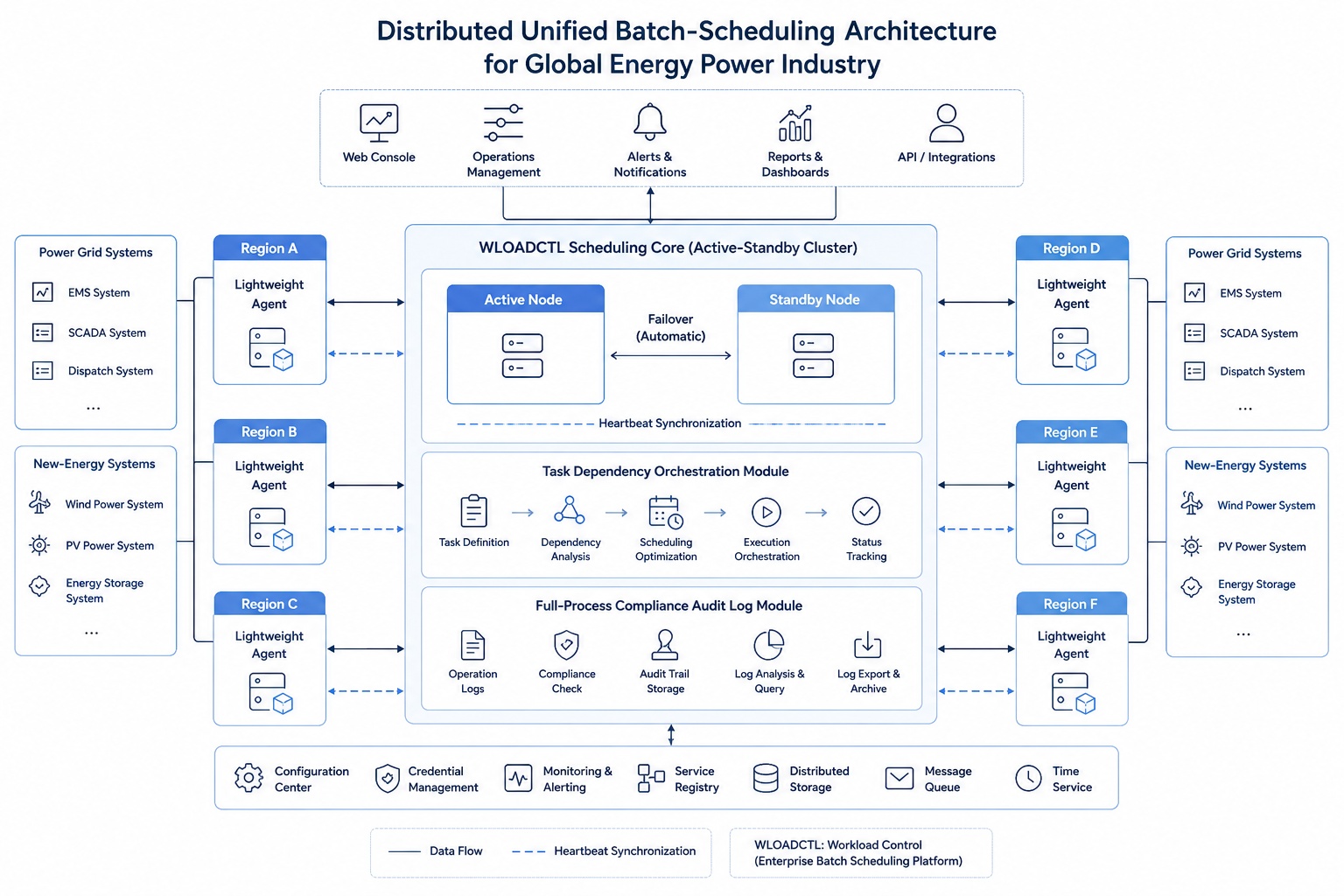
The enterprise deployed WLOADCTL to build a unified global batch scheduling platform, realizing standardized automation and full-link compliant management of energy business tasks.
Distributed global scheduling architecture: Lightweight Agent nodes are deployed in regional server clusters to uniformly manage cross-platform batch tasks under diverse operating environments, eliminating regional data and scheduling silos.
Visual workflow orchestration: The platform sorts logical dependencies between equipment collection, load calculation, business settlement and compliance reporting, forming automated end-to-end business scheduling workflows.
High-availability fault-tolerant mechanism: Active-standby node deployment supports real-time synchronization and fast failover, ensuring 7×24-hour stable execution of all batch processing tasks.
Full-process compliance audit: The system automatically records all task triggering, adjustment, rerun and exception logs, meeting local industry supervision requirements and supporting one-click audit inquiry and export.
Precise time management and automatic retry: Fixed-cycle scheduling rules are configured for daily, monthly and annual settlement tasks, with intelligent retry for abnormal tasks to avoid business interruption.
Application Effect
Improved operational efficiency: Decentralized manual tasks are fully automated and centrally managed, greatly compressing batch processing cycles and ensuring timely completion of settlement and compliance reporting.
Enhanced business stability: The high-availability architecture eliminates single-point failures, realizing continuous, stable collection and analysis of global power equipment data.
Standardized compliance capability: Traceable operation logs and standardized scheduling mechanisms fully meet regional industry supervision standards, eliminating operational compliance risks.
Reduced O&M costs: Unified global monitoring enables rapid positioning and disposal of abnormal tasks, reducing manual O&M investment and improving refined operational management.