
GLOBAL AUTOMOTIVE MANUFACTURING GROUP
2026-03-01
Project Background
This multinational automotive manufacturing group owns multiple intelligent production bases and component supply chain factories, covering vehicle assembly, parts processing and quality inspection. Its industrial batch scheduling faced prominent challenges in cross-factory collaborative operations.
Complex cross-factory task dependencies: MES, WMS and ERP systems of different production bases operated independently. Scattered production statistics and reconciliation tasks caused inconsistent production data.
Difficult coordination of multi-frequency tasks: High-frequency equipment collection tasks and low-frequency daily/monthly settlement tasks could not be matched accurately, resulting in frequent delays and execution errors.
Strict industrial data localization rules: Regional industrial supervision requires local storage and scheduling of production data, restricting cross-region data transmission and bringing scheduling adaptation difficulties.
High difficulty in unified O&M: Lack of global unified monitoring platform led to centralized disposal difficulties for abnormal tasks, increasing manual intervention costs and restricting overall production efficiency.
Technical Solution
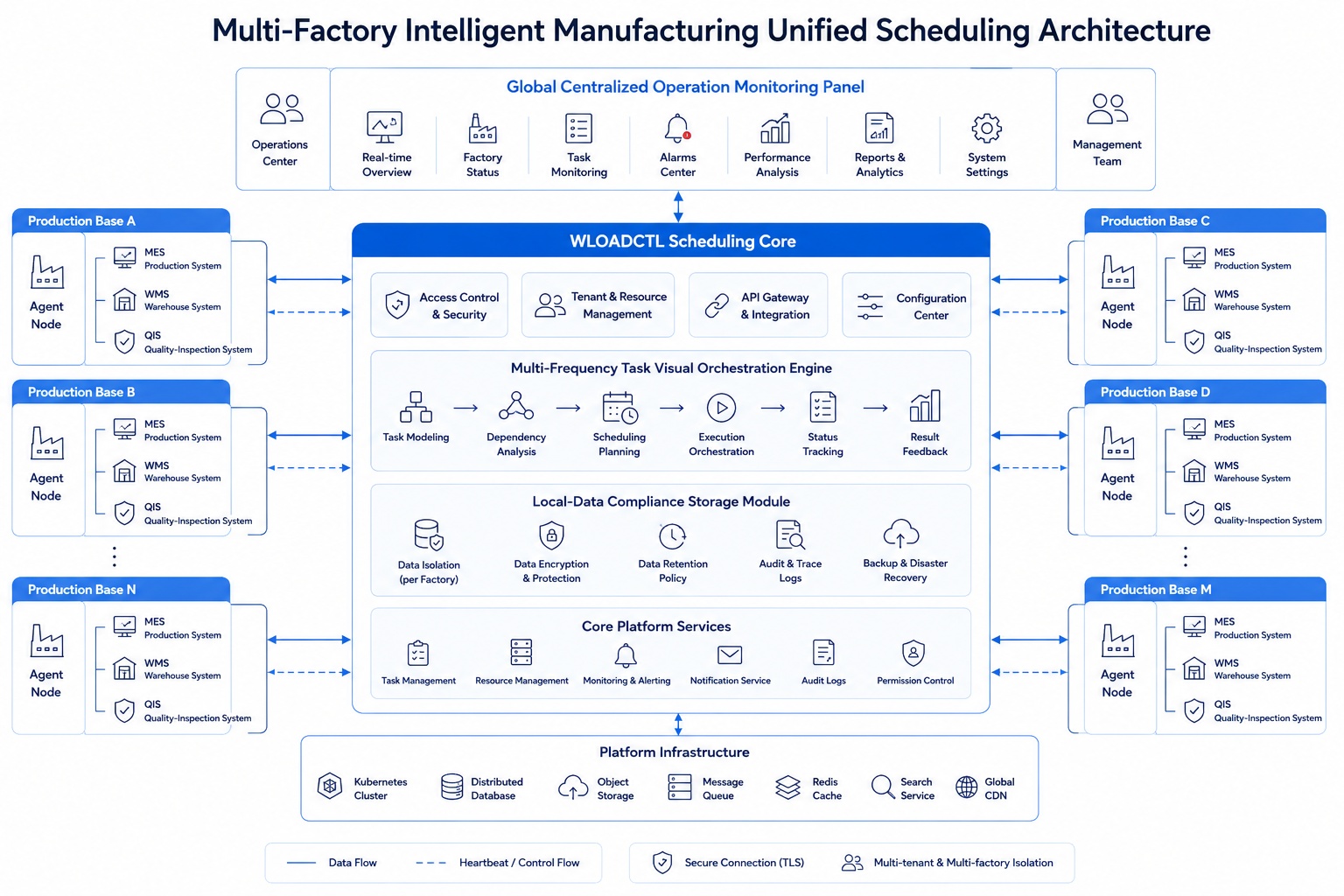
The group implemented WLOADCTL to build a global intelligent manufacturing scheduling platform, realizing standardized automated management of cross-base industrial batch tasks.
Cross-platform unified scheduling: Deploy distributed Agent nodes in production bases to adapt to heterogeneous industrial systems, realizing unified management of MES, WMS and quality inspection batch tasks.
Precise multi-frequency task orchestration: Customize exclusive scheduling rules for tasks of different frequencies to ensure orderly matching and sequential execution of high-frequency collection and low-frequency settlement tasks.
Localized data compliance scheme: Realize independent regional scheduling and local storage of production data, fully complying with industrial supervision and data localization requirements.
Global visual monitoring system: Centralize the display of task status of all production bases, support real-time alarms and rapid fault positioning, and reduce manual O&M pressure.
Full-link production automation: Automate the whole process of production data collection, quality analysis, output statistics and supply chain reconciliation to form an intelligent production scheduling closed loop.
Application Effect
Improved production accuracy and stability: Precise dependency scheduling eliminates task conflicts and data inconsistencies, stabilizing the production rhythm of intelligent factories.
Standardized industrial compliance: Localized scheduling and data isolation mechanisms fully meet multi-region industrial data supervision standards.
Enhanced collaborative production efficiency: Cross-factory unified scheduling reduces redundant manual operations and shortens industrial data processing cycles.
Upgraded refined management: Global centralized monitoring realizes fine-grained task management, effectively reducing production O&M costs and improving product quality control.