
GLOBAL LOGISTICS & SUPPLY CHAIN GROUP
2026-03-01
Project Background
This global integrated logistics group provides international freight, warehouse storage, cross-border distribution and supply chain financial services. Its cross-border batch business faced prominent pain points such as scattered tasks, peak pressure and complex compliance rules.
Disordered cross-system task dependencies: Inventory reconciliation, freight settlement and customs declaration tasks were distributed in heterogeneous systems, prone to execution confusion and data dislocation.
Explosive peak scheduling pressure: Shipping peaks and shopping festivals brought massive batch tasks, and traditional scheduling could not balance resources, causing core business blockage.
Multi-region data supervision restrictions: Different countries have independent data sovereignty and customs rules, requiring localized task processing and isolated data management.
Poor task controllability: Lack of unified monitoring led to untimely discovery of settlement errors and task failures, delaying supply chain adjustment and increasing operational costs.
Technical Solution
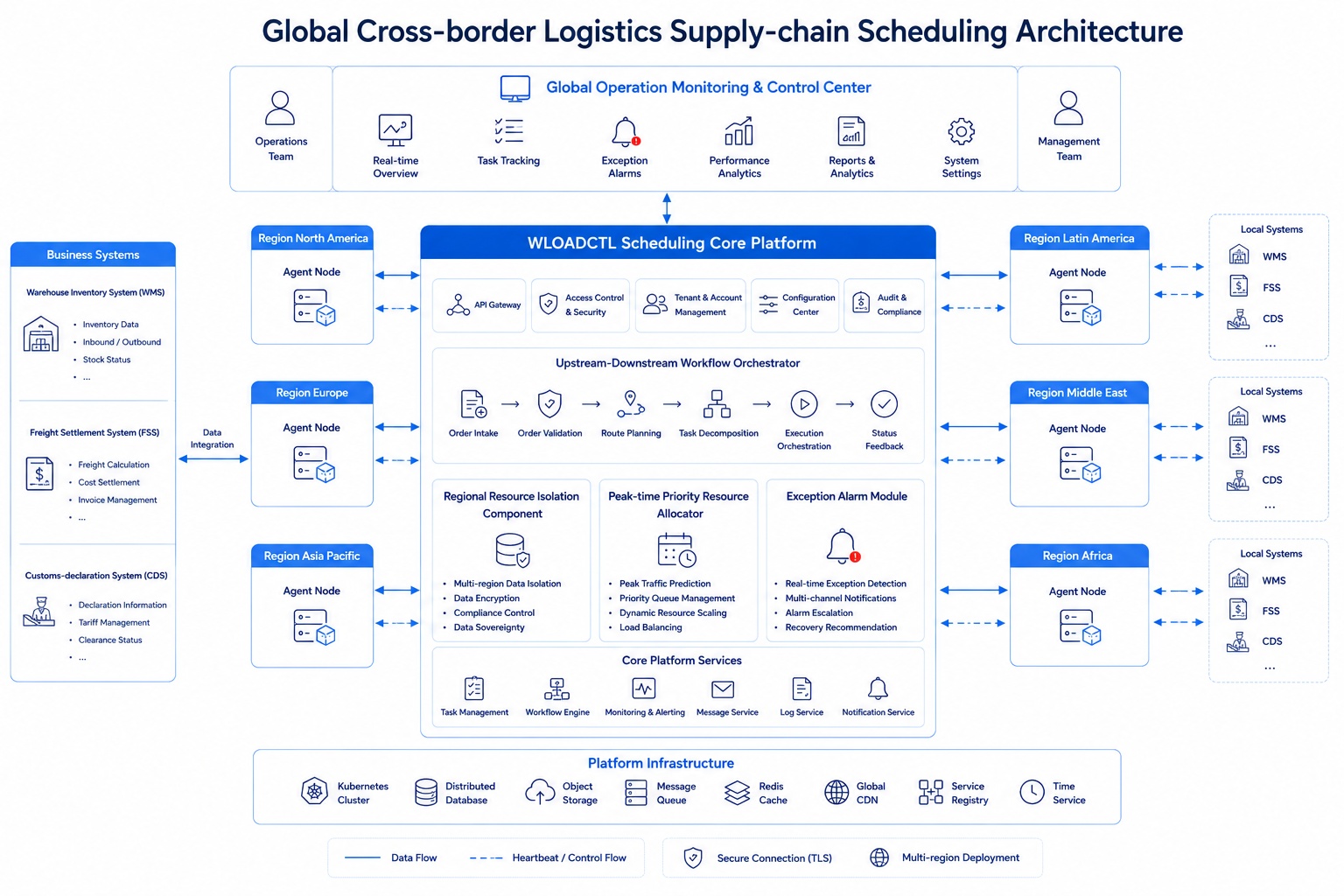
The group deployed WLOADCTL to build a global cross-border logistics unified scheduling platform, realizing full-link automation and compliant management of supply chain batch tasks.
Centralized batch task management: Integrate warehouse inventory, freight settlement, order statistics and customs declaration tasks to unify decentralized regional scheduling resources.
Visual business link orchestration: Sort upstream and downstream task dependencies to form standardized end-to-end automated execution workflows for logistics business.
Regional isolated scheduling mechanism: Realize independent resource scheduling and localized data processing to adapt to multi-region customs and data supervision rules.
Intelligent peak resource allocation: Set priority rules for core tasks such as settlement and declaration to ensure stable business execution during peak periods.
Full-process exception monitoring and alarm: Real-time monitoring of all logistics batch tasks supports rapid troubleshooting and disposal of abnormal tasks.
Application Effect
Improved global data accuracy: Standardized task orchestration eliminates cross-system data confusion, realizing precise reconciliation of inventory and freight data.
Stable peak business capability: Intelligent resource scheduling effectively supports high-concurrency batch tasks during shipping peaks, improving global service capacity.
Eliminated cross-border compliance risks: Regional isolation and localized processing fully comply with multi-country data and customs supervision requirements.
Reduced supply chain operational costs: Automated batch processing and efficient exception disposal greatly improve the refined operation level of global logistics business.